Saturday, July 19, 2008
Grizzly Adams
I found this collection of Sports Illustrated's most usual covers a while back, but I still feel the need to comment on this cover in particular. It was kind of shocking to see an SI cover story starting a discussion about whether or not it would be a good idea to deliberately wipe out the wild grizzly bear population of North America. Even if SI still deemed the outdoors a worthy topic for a cover story, I can't imagine that they would ever consider debating the deliberate extinction of a species. I read the article, and while the author takes an anti-forced extinction position, he views the eventual extinction of the grizzly as a forgone conclusion. Nearly 40 years after this article was penned, the grizzly has been removed from the endangered species list (at least, in Yellowstone National Park), so overall, the grizzly's future has been somewhat brighter than this article predicted.

Friday, July 18, 2008
Wall E. Weasel's
I've read some reviews that have put Wall-E on the short list for best picture of 2008. While I wasn't quite that enthusiastic about it, I still thought it was a good movie. Like all good animation, it works on several levels. It's got fun stuff for the kids, not-so-subtle references to 2001 and other pop culture ephemera for the adults, and killer animation for people who enjoy movies solely for their visuals. Like most children's entertainment that is in any way creative or interesting, it has generated a fair amount of controversy. This is all pretty silly, of course. I think that the real message that Wall-E is trying to convey is the old adage about how the unexamined life is not worth living. All of the characters in the movie are forced at some point to choose between the comfortable status quo and the unknown. My one complaint is that after building up all of this tension, the ending is somewhat anti-climatic and unsatisfying. Perhaps they were just keeping the powder dry for the sequel.
Wednesday, July 16, 2008
Love Is
I've been using last.fm's "love" feature to flag songs that I love in order to inform their music selection algorithm about my tastes, but I've also been using it as a way to keep track of interesting artists that I've heard for the first time on last.fm so I can go back and explore more of their music at some point in the future. Needless to say, I was kind of bummed when I learned that last.fm doesn't provide a feed of your entire loved music history. Fortunately, a fellow named Jamie Thompson is hosting a little last.fm loved music feed service that anyone with a last.fm account can use to create a feed of their entire loved music history. Here's my feed. I've also added it to the right-hand side of this blog underneath the blogroll.
Tuesday, July 15, 2008
For Eyes

As you can see (unless you need glasses), I have recently joined the those in need of corrective lenses club. I probably joined the club a while back, but I didn't get my eyes checked out until recently. I don't know when I first noticed that my vision was starting to degrade, but it was obvious by last fall when I was in China and my brother and his surgically enhanced eyes were able to easily read street signs that I could barely decipher (pretty amazing, given that he doesn't even know Chinese). Even though my vision is still pretty good, I notice a remarkable difference when I put on my glasses. Everything more than a couple feet away from me is noticeably sharper. It's nice to be able to see in HD again.
Friday, July 11, 2008
Sandwich Artistry
I've always been a big fan of sandwiches, and I discovered a new favorite on our trip to Europe. I discovered it at the Schönbrunn Palace snack bar of all places. It's simple, a baguette with Brie a couple strips of green pepper, and a healthy amount of fresh cracked pepper. I was very hungry when I had it for the first time, so it's not surprising that I found it so delicious, but I've made it a few times since getting back home and it still tastes great. Bon appetit.
Thursday, July 10, 2008
LRU For Dummies
I needed a Least Recently Used data structure for some work I was doing so I went out to see what I could find in the open source world. I have used the LRUMap from Commons Collections before, but I was hoping to find one that makes use of generics. I checked out Google Collections, but they don't have any LRU data structures (yet). Fortunately, I check out the JavaDocs for LinkedHashMap on a hunch and was happy to discover that Sun already implemented an LRU algorithm in LinkedHashMap that can be enabled by setting a constructor parameter. They even provided a protected method that can be overriden in a subclass to create a fixed-size LRU map in fewer than 10 lines of code. The JavaDocs explain it all if you're interested.
Tuesday, July 08, 2008

Monday, July 07, 2008
The Horror
I recently picked up Joseph Conrad's Heart of Darkness. I'm not entirely sure why I decided to read it, other than it's one of many notable works of literature that I've never read. I went to the library looking for a work of fiction, but beyond that, I didn't really have anything in mind. I enjoyed the book, but I had a few problems with it. The first was that I picked up the Norton Critical Edition, which clocks in at 420 pages. The story itself is only 70 of those pages. I failed to consult the table of contents before diving into it, so I thought that it was a novel-length story. I tend to read longer stories differently than shorter ones. I don't pay attention as closely at the start of a longer story since I figure that the first 20 or 30 pages are just going to start developing the themes and characters that will be fully fleshed out throughout the course of the book. Once I was 20 or 30 pages into Heart of Darkness, I was almost halfway through the story. I didn't realize how short the story was until I was about 2/3rds of the way through it, at which point, I had no desire to go back to the beginning and read it more closely.
My bigger problem was the extent to which the story has been woven into western culture over the past 100 years. It's hard to approach a work of literature from a fresh perspective after you've already seen it parodied on Seinfeld. While I didn't read much of the source material, criticism, and historical information presented in the other 350 pages of the Norton Critical Edition, that which I did read was in some ways more interesting to me than the story. I'd still say that the story is required reading for any student of the scramble for Africa.
My bigger problem was the extent to which the story has been woven into western culture over the past 100 years. It's hard to approach a work of literature from a fresh perspective after you've already seen it parodied on Seinfeld. While I didn't read much of the source material, criticism, and historical information presented in the other 350 pages of the Norton Critical Edition, that which I did read was in some ways more interesting to me than the story. I'd still say that the story is required reading for any student of the scramble for Africa.
Sunday, July 06, 2008
Correction
I used to read letters to the editor pretty religiously, but I've all but stopped reading them over the past couple of years. I guess I used to find them mildly amusing, but I grew tired of the inane and barely coherent arguments that are the bread and butter of typical letter to the editor writers. Fortunately, I skimmed the letters to the editor in today's ProJo because I came across a surprisingly good and informative letter to the editor. It's a refutation of several of the great myths of Rhode Island history, including one that I've perpetuated on my blog. As it turns out, the law passed in Rhode Island in May of 1776 only repealed the requirement that all government officers swear allegiance to the king; Rhode Island didn't actually declare independence until July 18, 1776 when the legislature ratified the Declaration of Independence.
Independence Day
I finally made it up to Boston for the 4th of July this year. I've wanted to catch the fireworks in Boston ever since I lived there, but for various reasons, it never worked out. I wasn't sure if I could still be impressed by a fireworks display, but I have to admit that they take things to another level on the 4th up in Boston. They had fireworks that lit up the sky with smiling faces and cubes when they exploded. They had fireworks that slowly floated back down to earth on balloons. They had a grand finale so massive that the smoke from the fireworks that exploded at the beginning of the finale practically washed out the explosions at the end.
One of the great things about the 4th of July is it's a pretty low-key holiday. The only things that are expected of you are eating, drinking, and watching explosions. I was pleased that even in Boston, one of the few legitimate 4th of July destinations, everything is still pretty low-key. With the exception of the crowd, the "celebrity" guests, and the sheer volume of firepower on display, it really wasn't any different than watching the fireworks at a park in Anytown, USA.
One of the great things about the 4th of July is it's a pretty low-key holiday. The only things that are expected of you are eating, drinking, and watching explosions. I was pleased that even in Boston, one of the few legitimate 4th of July destinations, everything is still pretty low-key. With the exception of the crowd, the "celebrity" guests, and the sheer volume of firepower on display, it really wasn't any different than watching the fireworks at a park in Anytown, USA.
Friday, July 04, 2008
Iron Man
After two unsuccessful attempts, we finally caught Iron Man last night. With the exception of the Batman franchise, Michelle is usually more excited about comic book/action adventure movies than I am. While we both enjoyed Iron Man, I definitely liked it more than she did. It's not a theatrical masterpiece, but it's highly entertaining and incredibly whimsical. I suspect that most people don't go into superhero movies hoping for whimsy, but as an unabashed fan of the 1960s Batman TV series, I have always loved superhero movies that don't take themselves too seriously and constantly wink at the audience. If that's not your thing, Iron Man still has enough explosions and high-tech gadgets to keep up appearances.
Thursday, July 03, 2008
West Side Story
Yesterday, I biked to work for the first time at my present job. It was actually the first time I've biked to work in seven years. This is the first job I've had in a while that has the facilities to support bicycle commuting (showers and bike storage) and is close enough to home that I can still make it to and from work in a reasonable amount of time when traveling by bike. I really should have done this a lot sooner, but it's taken me a while to find a good bike route across the west side of Providence. I figured out most of the route that I wound up taking last summer, but at the time, I felt like it had a couple of high traffic chokepoints that I wouldn't be able to make it through so I started looking for a new route that went up the more bike-friendly east side. After trying a friend's route across the west side that involved riding across Federal Hill, I decided to give my old route another try. After fighting the traffic on Dean St., riding around Olneyville Square suddenly didn't look so bad. As it turns out, the traffic on my route is not as a bad during the weekday commute as it is on a Saturday morning, since the most of the high-traffic areas are commercial districts that don't see as many shoppers during they week as they do on weekends.
Here's a link to the main section of my route. It goes from Park Ave. and Cranston St. to Branch Ave. and Charles St. I don't actually follow the route that I've mapped out between Park Ave and Webster Ave; instead, I follow the Washington Secondary Bike Path.
Hopefully, I'll be able to bike to work at least a couple times per week for the rest of the summer. It takes me just over twice as long to bike as it does to drive (40 minutes vs. 15). Unless gas prices shoot up by a couple more dollars per gallon, I'm not really going to be saving myself much money, but I should get some good exercise.
Sunday, June 29, 2008
Alice Again
One of the fun things about blogging is that after you've done it a while, you'll start to notice patterns in your writing that you never would have expected. When I started blogging, I never expected that I would have so much to say about Alice Cooper. To wit, while walking around the shopping mall inside of Vienna's Gasometer a few weeks ago, I noticed that it had its own walk of fame. Since Falco and Ahnold are the only Austrian celebrities I can think of off the top of my head, I wasn't surprised that I had never heard of anyone in the walk of fame. Nor was I surprised to see that one person in the walk of fame that I did recognize was Alice Cooper. Normally, I might have a little pity for an aging rocker who decided it was worth his time to let a second-rate Austrian shopping mall immortalize him in their walk of fame, but I feel like Alice Cooper's enshrinement was more of a labor of love and whimsy than desperation.
We were driving home after our flight back from Vienna when I discovered that the local classic rock radio station is now airing Nights with Alice Cooper (only on Saturday nights, sadly). One of the deep cuts that Alice treated us to was one of his own, a song I had never heard before called "I Love America". It's essentially a less profane, cold war version of "America - Fuck Yeah!". It's not all that funny or clever, but it's distinctly Cooper.
We were driving home after our flight back from Vienna when I discovered that the local classic rock radio station is now airing Nights with Alice Cooper (only on Saturday nights, sadly). One of the deep cuts that Alice treated us to was one of his own, a song I had never heard before called "I Love America". It's essentially a less profane, cold war version of "America - Fuck Yeah!". It's not all that funny or clever, but it's distinctly Cooper.
Tuesday, June 24, 2008
The Ice Harvest
After hearing about Gavin Weightman's The Frozen-Water Trade: A True Story shortly after it was published in 2003 and having my interest rekindled after noticing a small sign on an old warehouse in Charlestown commemorating the frozen water trade while walking the Freedom Trail in 2006, I finally got around to reading the book. The book is largely the story of Frederic Tudor, the man who was largely responsible for creating the ice industry prior to artificial refrigeration. Before I heard about this book, I had no idea that people ever harvested ice from lakes and rivers and stored it so it would be available during the warmer months. I had heard of icehouses and iceboxes but I guess I never really thought about where the ice came from. When I learned that Tudor shipped ice to the Caribbean, the American South, and even to India without artificial refrigeration, I was astounded and it was that astonishment that led to my interest in the book.
Once I was able to wrap my head around the idea that the ice trade, the book didn't really have much else to offer in the way of shocking realizations. The book devoted some space to one of Tudor's partners, Nathaniel Wyeth, who was responsible for most of the technical innovations that made it possible to harvest large volumes of ice from frozen lakes and ponds in an efficient and cost-effective manner. Once that was worked out, the ice business was like any other weather-dependent business. Tudor exploited the technical advantages that Wyeth provided to harvest more ice in less time at a lower cost than his competitors, but in the end, his success had more to do with the network of relationships he built around the world and his refusal to cede any ground to his competitors.
The most interesting thing about the whole story was not the supply side of the ice business; it was the demand side. The US was the first country where year-round access to ice in all climates was considered a necessity instead of an extravagant luxury. While there certainly was demand for ice in the tropical climes of the Caribbean and India, ice was still seen as more of a luxury good. Even today, American's attitudes towards ice differ from the rest of the world. Sit down at a restaurant anywhere in the 50 states and the first thing that you'll get is a tall, cool glass of ice water. American brewers have spent so much time and money trying to convince customers that their beer is the coldest that it's become the stuff of parody. The books doesn't offer any explanation for American's love of ice. It might be good old American exceptionalism, but I have my own theory. The climate of the eastern part of North America is a lot more variable than that of Western Europe. The average temperature in Philadelphia during the summer is about the same as the average temperature in Rome during the summer, but Philadelphia gets much colder in the winter. There's really nowhere in the eastern US that has comfortable weather throughout the winter and the summer, so it makes sense that in addition to the obvious demand for summer ice in sweltering American South there would also be more demand for summer ice in Northeastern US cities than anywhere in Western Europe.
Monday, June 23, 2008
George Carlin
I knew this morning when I heard that George Carlin had passed away that I would read many tributes in the blogosphere today. Certain deaths really resonate in blogging world. Generally, they feature men who did great or at least interesting things while living by their own credo and not worrying too much about what the rest of the world thought of them. I suspect that deep down, this is how most of us bloggers would like to see ourselves remembered and therefore, it should come as no surprise that we feel the need to mourn the passing of the great elders of the tribe to which we aspire.
I'm not going to eulogize Carlin because I'm not that familiar with his body of work. I liked the pieces of it that I managed to catch, but I never really sought it out. I will mention that I was just thinking about what he was up to and how old he was after his name came up in a conversation I had with some friends about Bill & Ted's Excellent Adventure (in which Carlin plays Rufus, of course) on Saturday. I'm not suggesting that the act of me thinking about George Carlin for the first time in a few years led to his passing 24 hours later, but it is strange how things like that happen sometime. Perhaps Carlin once did a bit about this phenomenon.
I'm not going to eulogize Carlin because I'm not that familiar with his body of work. I liked the pieces of it that I managed to catch, but I never really sought it out. I will mention that I was just thinking about what he was up to and how old he was after his name came up in a conversation I had with some friends about Bill & Ted's Excellent Adventure (in which Carlin plays Rufus, of course) on Saturday. I'm not suggesting that the act of me thinking about George Carlin for the first time in a few years led to his passing 24 hours later, but it is strange how things like that happen sometime. Perhaps Carlin once did a bit about this phenomenon.
Sunday, June 22, 2008
Das dritte European Impressions
I can't look at the tiles on the roof of Stephansdom without thinking of the Jamaican Flag. Apparently, it's a rather recent addition to the church.
Vienna was full of European soccer fans while we were visited since it is one of the host cities for the 2008 Euro Cup tournament.
Of all the countries whose fans traveled to Vienna for the tournament, Poland had the largest and most vocal contingent.
I've never felt more connection to my Polish heritage than I did while riding the U Bahn with a horde of Polish soccer fans in full regalia on their way back from the stadium.
For a city that was packed with European soccer fans, there was surprisingly little rioting going on while we were there. Many of Vienna's more delicate landmarks, including the Burggarten, were closed to prevent them from getting trashed.
This was the first time I've ever visited multiple countries on an overseas trip and it was interesting to see the contrasts between Paris and Vienna that I probably wouldn't have noticed had I visited them on separate trips.
I didn't see a single street musician my entire time in Vienna. I was disappointed, but I chalked it up to the Euro 2008 tournament.
The grounds at the Belvedere Palace were not in very good condition and even if they were in good shape, they wouldn't have been anywhere near as impressive as the grounds at the Schönbrunn Palace.
The art museum in the Oberes Belvedere had a decent collection of German Expressionist paintings, but it was not as rich of a collection as I would have hoped for a city that was so important to that movement.
I'm better at passing as a European than I imagined. The flight attendants on our intra-European flights generally addressed me in German before English. Vendors on the streets of Vienna guessed that I was Polish, Russian, and German before American (as long as I hadn't said anything to them yet).
Saturday, June 21, 2008
European Impressions, Part Deux
The Musée d'Orsay has more famous and familiar paintings per square foot than any other museum I've ever visited. It's an astounding collection for any museum, let alone a museum that opened in 1986!
Regardless of what your Paris guidebooks may tell you, if you want to visit the street markets of Paris, you better go first thing in the morning and preferably on a weekend.
I've now seen three Statues of Liberty (NYC, Tokyo, Paris)
Hot dogs are much more readily available in Paris than I ever would have imagined.
One of the few American meals that I miss while traveling is a nice greasy breakfast. Fortunately, we were able to get one in Paris.
When visiting places with a lot of history, it's interesting to see what events and people they choose to focus on at their historic attractions. Most of the historic attractions in Paris focused on the revolution, of course. In Vienna, they seemed to focus on Maria Theresa and Franz Josef I, their most famous and last* monarchs, respectively. Marie Antoinette comes up quite a bit in both cities, since she was the daughter of Maria Theresa and wife of Louis XVI.
* Technically, Franz Josef I wasn't the last Habsburg monarch, but he reigned for 68 years and the monarchy was dissolved two years after his death
I've developed a fondness for Roman Ruins, no matter how unimpressive they are.
French coffee is stronger (and better) than Viennese coffee (Don't take my word for it, however, as I only had coffee one time in each city).
Tuesday, June 17, 2008
Some European Impressions
Paris is as beautiful as everyone says - but not in the way that I expected. It has a gritty, lived-in kind of feeling that only enhances its beauty, in my opinion.
Paris is more multicultural than I was led to believe.
The Paris Metro system is one of best public transit systems I've ever ridden. If we had to wait more than two minutes for a train, it was a long wait.
The only thing worse than the crowds at the Louvre were the people who were taking pictures of all of the paintings. I hope that the art museums of Paris (and the rest of the world, for that matter) start prohibiting all photography in their galleries. In the age of digital photography, it's not enough to just outlaw flash photography.
I was under the impression that the only kinds of stores on the Champs-Elysees were high-end luxury goods stores. It certainly had plenty of these, but there were plenty of shopping opportunities for those on more of a budget.
Even after taking into account the weakness of the dollar, drinkable wine is still very affordable in France.
The best part about worldwide theatrical releases of films is seeing how the titles get translated. What Happens in Vegas was Jackpot in France and Love Vegas in Austria. I guess the Greater Las Vegas Convention and Visitors Bureau uses a different slogan in its foreign language marketing materials. (Note: this observation should not be construed as an endorsement of the film What Happens in Vegas)
Saturday, June 07, 2008

Thursday, June 05, 2008
Who Shot Nice Guy Eddie?
In an ongoing attempt to turn my blog into the Internet's premier source of Quabbin Reservoir related news, I present this article from last Sunday's ProJo. It sounds like a nice place to do some hiking, biking, or just plain old relaxing, especially in the fall. I may have to make the trip up there sometime this autumn. If I do go, rest assured, you'll read about it here first.

Friday, May 30, 2008
Slack to the Future
Over this past Memorial Day weekend, I was thinking about how it was a year ago that Ace Cowboy turned the lights off over at his personal blog. For whatever reason, it seems like it's been way longer than a year since Slack LaLane fell out of my daily rotation. I'm happy to report that Ace has gotten the proverbial band back together over here. Kudos bar, indeed.
Thursday, May 29, 2008
Viral Donut
The I Love Donuts billboard is back up in Providence. In case you've never seen it, it's just a picture of a donut and a URL - ILikeDonuts.com. I finally went to the website and it turns out it's just a advertising company trying to drum up business. I guess I walked right into their trap.
Monday, May 26, 2008
Dewey Defeats Truman
So on Friday night, when I thought I was witnessing baseball history, it turns out I was actually watching a rerun of Monday's Red Sox game. Unless John Lester throws a no-hitter this afternoon, he's not the second player in MLB history to throw back-to-back no-hitters. I suppose I should have been skeptical about Lester throwing on four day's rest against the Royals at home on a night that, according to the Red Sox schedule, they were supposed to be playing in Oakland, but I was too caught up in the moment to think about it.
Sunday, May 25, 2008
I Want My TVP
I recently came across this Vandermark 5 music video on last.fm. I'm not joking when I call it a music video, it's not just footage of them playing in concert, it's got multiple camera angles, close-ups, and all sorts of post-production touches.
As far as I can tell, it was aired on TVP Kultura, a Polish arts and culture television station. I never imagined that I would ever be envious of Polish television. If they had programming like this in Poland 100 years ago, perhaps my great-grandparents never would have emigrated to the US.
As far as I can tell, it was aired on TVP Kultura, a Polish arts and culture television station. I never imagined that I would ever be envious of Polish television. If they had programming like this in Poland 100 years ago, perhaps my great-grandparents never would have emigrated to the US.
Saturday, May 24, 2008

Friday, May 23, 2008
No Way
Congrats to John Lester of the Boston Red Sox for throwing his second no-no of the week. I happened to flip to the game tonight in the fifth inning and noticed that Lester was back on the hill and hadn't given up a hit yet. I usually don't pay much attention to the Sox or regular season baseball, but I'm glad I caught this. I know that almost everything that could have possibly happened on a baseball field has already happened before, but I don't think there are too many pitchers who have thrown two no-hitters in the same week.
Identity Crisis
If you've read an in-flight magazine in the past year, you've probably seen ads for LifeLock, the company that has so much confidence in their identity theft prevention service that they made publicly divulging their CEO's social security number the centerpiece of their ad campaign. What could possibly go wrong?
Thursday, May 22, 2008

Wednesday, May 21, 2008
Back to the Future
It's taken about 15 years, but it's finally happened - the Red Wings and the Penguins are finally meeting in the Stanley Cup finals. This was a common prognostication, especially for this guy, back in the early 90s when the Penguins last ruled the NHL and the Red Wings were establishing themselves as one of the league's premier (regular-season) teams. In 1992, the last time the Penguins advanced to the finals, they faced an original six team with a backup goaltender by the name of Dominik Hasek. This time around, they're facing an original six team with a backup goaltender... you see where this is going. Hasek introduced himself to the NHL in game four of the 1992 finals when he came on in relief of Ed Belfour. By then, the Blackhawks had already lost the series, but Hasek's brilliance at least gave them a chance to stave off the sweep. As a Red Wings fan, I'm hoping that the Penguins of 2008 don't fare as well as their 1992 edition and I'm also hoping that Hasek's NHL career doesn't end the same way it began.
Sunday, May 18, 2008
Feast or Famine
In preparation for our trip to London last year, I read a lengthy history of the British Empire. In preparation for our upcoming trip to Paris, I decided to look for some novels featuring the city of lights. My first choice was Hemingway's A Moveable Feast, but they didn't have a copy of it available when I went to the library and I wasn't about to embark on a transcontinental flight without some reading material, so I picked up Kiffe Kiffe Tomorrow, a book that I found a recommendation for on a random literature blog. It's the debut novel by Faize Guene, a Algerian-French college student. As I thumbed through the book in the library, I realized that I couldn't recall the last book I read that was written by a woman. Perhaps breaking this streak with a book written by a teenager wasn't the greatest idea. It was a light read and heartwarming without being too sentimental, but it didn't do a whole lot for me. With the exception of about three pages, none of the story actually took place in Paris. Instead, the book paints a fairly vivid picture of the much less glamorous immigrant neighborhoods on the outskits of Paris. Since I doubt we'll be making it out there on our trip, this book at least gave me a taste of what life is like for people stuck between France and their homeland.
I did eventually get my hands on a copy of A Moveable Feast, which I just finished reading. Not all of the stories in the book take place in Paris, but the ones that do are quite evocative. I fear that the stories may have romanticized the Parisian cafe well beyond what any establishment could hope to offer, however. I probably learned more about Hemingway than Paris from the book. I've always pictured Hemingway as impossibly rugged and gruff; uncomfortable unless he was in a bull fight, boxing match, war, safari, or some other sort of manly pursuit. His persona in A Moveable Feast doesn't really fit this description. The Hemingway of A Moveable Feast is rather docile and domestic. His persona does start to change in the final story, which contains some of the anger and philandering that I have always associated with Hemingway.
I did eventually get my hands on a copy of A Moveable Feast, which I just finished reading. Not all of the stories in the book take place in Paris, but the ones that do are quite evocative. I fear that the stories may have romanticized the Parisian cafe well beyond what any establishment could hope to offer, however. I probably learned more about Hemingway than Paris from the book. I've always pictured Hemingway as impossibly rugged and gruff; uncomfortable unless he was in a bull fight, boxing match, war, safari, or some other sort of manly pursuit. His persona in A Moveable Feast doesn't really fit this description. The Hemingway of A Moveable Feast is rather docile and domestic. His persona does start to change in the final story, which contains some of the anger and philandering that I have always associated with Hemingway.
Thursday, May 15, 2008
Streakhouse, Please
While I rarely dine at fast food restaurants, I do have a soft spot in my heart for their advertisements. This recent Burger King spot is one of my current favorites.
I love the idea of someone who wants a steakhouse burger so badly that he'll gladly wreck his own car and the car in front of him in the line at the drive through just to get his burger a little bit faster. I also love how he didn't bother to actually place an order; he just pulled up to the window and pushed out the car that was already there. Even if this was socially acceptable behavior, it wouldn't have helped him get his steakhouse burger any faster since you still have to actually order your meal before you can pick it up at the drive through window. Finally, the way he politely says "steakhouse, please" with a demented smile on his face once he pushes the other car out of the way is priceless. After completely flaunting the most basic rules of driving and drive through etiquette, he calmly places his order in a completely matter-of-fact way that would lead one to believe that he does this kind of thing every day.
I love the idea of someone who wants a steakhouse burger so badly that he'll gladly wreck his own car and the car in front of him in the line at the drive through just to get his burger a little bit faster. I also love how he didn't bother to actually place an order; he just pulled up to the window and pushed out the car that was already there. Even if this was socially acceptable behavior, it wouldn't have helped him get his steakhouse burger any faster since you still have to actually order your meal before you can pick it up at the drive through window. Finally, the way he politely says "steakhouse, please" with a demented smile on his face once he pushes the other car out of the way is priceless. After completely flaunting the most basic rules of driving and drive through etiquette, he calmly places his order in a completely matter-of-fact way that would lead one to believe that he does this kind of thing every day.
Tuesday, May 13, 2008
In the Zone
One of my favorite things about flying back home to Michigan is hearing the automated timezone announcement at Detroit Metro Airport. In case you've never heard it, it runs about every ten minutes in the terminal and announces in English, Japanese, and Mandarin that Detroit is in the Eastern Timezone. As far as I know, this is the only message that they bothered to translate into any foreign languages. I can appreciate how confusing it can be for someone who doesn't speak English to travel to the US, but is it really necessary to tell people the name of the current timezone in their native language? For starters, airports have clocks all over the place, so anyone who is confused about the current time after a 12 hour flight from Asia only needs to look around for a few seconds. Never mind the fact that I doubt people who live outside of North America are familiar with the names that we give the timezones over here. I've found that the only people who really need to be reminded that Detroit is in the Eastern Time Zone are certain residents of the northeast who think that the Central Time Zone begins somewhere west of Schenectady.
Monday, May 12, 2008

Sunday, May 11, 2008
Reservoir Dogs
On my flight back from San Francisco, we flew over the Quabbin Reservoir on the approach into Boston. The sun had just risen and it gave the reservoir a really eerie look. The view of it on Google Maps doesn't really do it justice. It made me think about reservoirs, and led me to conclude, correctly, that the Quabbin and Scituate Reservoirs are the largest inland bodies of water in Massachusetts and Rhode Island, respectively. I thought it was strange that I couldn't name a reservoir in any other place that I've lived until I realized that most of the other places I've lived have been near large and/or Great Lakes. From what I read on Wikipedia, the stories of the creation of these reservoirs sounds fascinating, since they were both constructed in the early part of the 20th century over land that was already settled and populated.
Friday, May 09, 2008
Wi-Infidelity
How's this for irony? I've spent most of this week in the high technology capitol of the world at what is probably one of the largest software developer conferences in the world and today is the first day I've had reliable access to the Internet. Did I miss anything good? I could have found a coffee shop or, *gasp*, actually paid for WiFi access at my hotel, of course, but those things involve work and/or money. I can understand how 15,000 software developers and their arsenal of wireless devices could overwhelm the wireless network at a convention center, but you'd think that if any place could handle that kind of load, the premier destination for high-technology conferences could.
Friday, May 02, 2008
Swedish Fish
The performance of Detroit's Swedish contingent in last night's Wings-Avs game was probably the greatest gift that Sweden has given the world since reasonably priced, some assembly required, particle board furniture. If only Babcock would put three of the Swedish forwards together to create the Ikea line.
Thursday, May 01, 2008
My Giant
I just finished watching the first season of Human Giant, MTV's newish sketch comedy show. I had never heard of the show until I read this AV Club review. I haven't watched MTV intentionally in at least 10 years so I was kind of skeptical, but I gave it a chance and I'm glad that I did. It's pretty funny stuff. The sketches are all pretty short, but I think that's a good thing. Sketch comedy is so hit-or-miss that it's better to end a good skit early than let a bad one drag on. The sketches are more conceptual than SNL and a lot more absurd, so I definitely appreciated that. With a three-man cast and not a lot in the way of production values, it's a lot more raw than other sketch comedy shows. The humor isn't all that insightful. They occasionally take shots at pop culture and current events, but it's mostly three guys performing reductio ad absurdum on everyday situations.
Wednesday, April 30, 2008
What a Drag It Is Getting Old
I may be getting a bit ahead of myself here, but one of the things I think about from time to time is what kind of an old person am I going to be. Will I be one of those old people who reflexively rejects anything new and different? I doubt it, but even at the ripe old age of 31, I occasionally catch myself rejecting new and unfamiliar things without giving them a fair shake.
I was thinking about this a lot today. As you probably haven't heard, the big news in the sports blogosphere right now is las night's episode of Costas Now, on which Pulitzer Prize-winning journalist Buzz Bissinger launched a profanity-laced tirade against sports blogs in general and Deadspin's Will Leitch in particular. I don't think I'll ever react to any future forms of media distribution the way Bissinger reacted to sports blogs, but I'm not a professional writer and have no plans to become one, so I don't have as much skin in the game. While I don't think most people really "get" blogging, it seems like it's only professional journalists who feel threatened by what it represents who seem to be lashing out against it. I'm fairly confident that blogging is going to keep getting bigger and will eventually be recognized as a legitimate media distribution channel. In order for that to happen, the blogosphere will need to expand beyond its current sweet spot, which is a celebration of all things embraced by irreverent, nerdy, mostly male, gen X types. It's going to happen, of course, it's just going to take a little while for everyone else to get up to speed.
The thing that I find so exciting about the blogosphere (damn, I hate that word) is that as an irreverent, nerdy, mostly male, gen X type, I feel an immediate connection with so many of my fellow bloggers. As blogging becomes more mainstream, more people will be joining the club, and I'm sure that I'll start feeling some nostalgia for the good old days when you could jump into any blogging comment thread and drop an obscure Simpsons reference and be recognized as a member of a really dorky online fraternity. Of course, the great thing about blogging is that there's plenty of room for everyone. Deadspin doesn't have to disappear when someone starts publishing a more accessible sports blog.
Monday, April 28, 2008
On Average
Here's an interesting state-by-state breakdown of some demographic information and statistics that may or may not be relevant in this year's election. I was kind of surprised to see how average Rhode Island is in a lot of categories (gas price, illegal immigration, poverty, racial distribution, and per capita GDP). I feel like Rhode Island's small physical size throws off a lot of statistics because it has a smaller percentage of its citizens living in rural areas than most states. I was most surprised to see that at 47%, Rhode Island comes in 48th in the percentage of population who are married.
Friday, April 25, 2008
The Milford Academy
Gil Thorp is one of most delightfully absurd comic strips out there. I've been reading it off and on for as long as I've been reading the comics and I've never noticed anything that tied the fictional town of Milford to any particular location. Out of the blue, the past two installments of the Gil Thorp have featured the Mudlarks playing softball and baseball games against two fairly recognizable New York towns, Binghamton and Chenango. Out of curiosity, I checked to see if there is a town named Milford nearby and sure enough, there is. The creator of Gil Thorp hailed from New Milford, CT but never referred to any particular state in the strip. Perhaps his successor is trying not-so-subtly to position Milford somewhere in New York State's Souther Tier.
Thursday, April 24, 2008
Fly Like An Eagle
I've recently received a few postcards asking me to submit my current contact information for some sort of a national Eagle Scout database. I've ignored the requests so far, since I'm hesitant to respond to any unsolicited request for information. Besides, they already know where I live. Apparently, I'm not the only Eagle Scout blogger, because others have written about this already. A number of them have expressed reservations about responding to the campaign since they disagree with the BSA's anti-gay stance. While I also oppose the exclusionary policies of the BSA, my hesitance to send in my information stems more from laziness and privacy concerns than ideology. If I ever have a son and the BSA has not changed their policies by then, I'm not sure if I'll encourage him to join scouting or not. I certainly value the experiences that I had as a scout, but at the same time, I don't agree with the way they discriminate against gays and atheists.
Wednesday, April 23, 2008
How I Learned Stop Worrying and Love Gentrification
There's an anti-gentrification campaign going on in Providence right now. The idea that gentrification is a problem that is destroying urban America and needs to be resisted at all times is really something that I have trouble wrapping my head around. I'm willing to concede that development isn't always done in a way that is beneficial to the community, but the idea that anything that might displace the economically disadvantaged needs to be vociferously opposed seems incredibly counterproductive. I think there are plenty of cities out there, Providence included, that wish their biggest problem was gentrification.
I think the last paragraph of this is post is very illuminating. The author of this post (who is also quoted in the article referenced by the post) has a more nuanced view of gentrification than a lot of anti-gentrification activists, yet he is still basically saying that even if development helps a community in some very tangible ways (good jobs and affordable housing), the underlying problem is still there because the development will somehow ruin the character of the neighborhood. To me, that seems like a completely unrealistic standard for development in all but the most wealthy and/or historic areas, never mind blighted inner-city neighborhoods. As an aside, not surprisingly, The Onion has the best take on the matter.
I think the last paragraph of this is post is very illuminating. The author of this post (who is also quoted in the article referenced by the post) has a more nuanced view of gentrification than a lot of anti-gentrification activists, yet he is still basically saying that even if development helps a community in some very tangible ways (good jobs and affordable housing), the underlying problem is still there because the development will somehow ruin the character of the neighborhood. To me, that seems like a completely unrealistic standard for development in all but the most wealthy and/or historic areas, never mind blighted inner-city neighborhoods. As an aside, not surprisingly, The Onion has the best take on the matter.
Tuesday, April 22, 2008
The 'S' is for super and the 'U' is for unique...
I've been a geography geek for most of my life. I attribute at least some of it to my interest in sports. I learned where most of the major cities in the US were located by following the sports teams that played in them. Baseball was my first love and the only sport I really cared about until I was in the fourth or fifth grade. I had a baseball dice game that I used to spend hours playing as a kid. When I got really ambitious/bored, I would create my own baseball league. I'd create a handful of teams, give them names, and even design logos that I would draw on a map of the US. I'm pretty sure that my suburban Detroit hometown always had a franchise. In general, I liked to give franchises to places that didn't have big league ball teams. The only one of my expansion teams that I can remember are the Idaho Potatoes. Where am I going with this story? As most sports fans probably know by now, in all likelihood, the Seattle Sonics are going to be moving to Oklahoma City. For a number of reasons, this whole thing reminds me of the obscure baseball expansion franchises I created as a kid. They'll be the first major pro sports teams in Oklahoma and one of the few between the Mississippi River and the west coast (outside of Texas, Denver, and Phoenix). In terms of population, the Oklahoma City Metropolitan Statistical Area has about 1.2M people, which is not huge but it's larger than several other MSAs that have major professional sports teams. It's also much larger than Boise, the presumptive home of the Idaho Potatoes.
While OKC is about to join the ranks of medium-sized cities with major professional sports teams, in my opinion, Seattle is about to join an even more interesting club. Once the Sonics leave town, Seattle will have only two major professional sports teams despite being the 15th largest MSA in the country (and one of the few large non-sunbelt MSAs growing at an appreciable rate). Eventually, taxpayers somewhere are going to get sick of subsidizing sports arenas for billionaire sports owners. From what I know about the situation in Seattle, I don't think that's what happened here, but I could see it happening in a place like Seattle. Now that you can follow your favorite teams from anywhere on earth, hometown allegiences are not as important as they once were. Take an MSA that is full of transplants who didn't grow up following the local team and add an especially shameless owner who is trying to extort taxpayer dollars for a underachieving team in a sport other than football and possibly, baseball, and I think that a city just might be willing to give said team the heave ho.
While OKC is about to join the ranks of medium-sized cities with major professional sports teams, in my opinion, Seattle is about to join an even more interesting club. Once the Sonics leave town, Seattle will have only two major professional sports teams despite being the 15th largest MSA in the country (and one of the few large non-sunbelt MSAs growing at an appreciable rate). Eventually, taxpayers somewhere are going to get sick of subsidizing sports arenas for billionaire sports owners. From what I know about the situation in Seattle, I don't think that's what happened here, but I could see it happening in a place like Seattle. Now that you can follow your favorite teams from anywhere on earth, hometown allegiences are not as important as they once were. Take an MSA that is full of transplants who didn't grow up following the local team and add an especially shameless owner who is trying to extort taxpayer dollars for a underachieving team in a sport other than football and possibly, baseball, and I think that a city just might be willing to give said team the heave ho.
Monday, April 21, 2008
In Your Face
Here's an article about the latest trends in charitable giving. Instead of trying to coax people to pull money out of their pockets, charitable organizations are setting up websites that allow you to do things that you normally do online and capturing a portion of the advertising revenue. For example, instead of performing a web search through a regular search engine, you perform it through some charity's website. The charity sends your search off to a normal search engine and collects a small amount of money from advertisers for each search request that is brokered through their site.
One of the people profiled in the article is Dave King, a friend of mine who has created Lil' Green Patch, a Facebook application that works in a similar fashion. Instead of performing searches, you send virtual plants to your friends. For every 10 plants that you send, 1 sq foot of rainforest land in Costa Rica is saved. I've been using Facebook for a couple of months now and tending my own Lil' Green Patch, though I have to confess that I haven't been much of a virtual gardener. For whatever reason, I can't really get too enthused about sending virtual plants to people. In general, I've found that my personality is not all that compatible with Facebook. I have a pathological aversion to talking about myself and bothering other people, and really, what else can you do on Facebook other than talk about yourself and bother others? I realize that my fear is largely irrational, so maybe Facebook will help me get over my fear of annoying people. If anyone out there wants some virtual plants, let me know.
One of the people profiled in the article is Dave King, a friend of mine who has created Lil' Green Patch, a Facebook application that works in a similar fashion. Instead of performing searches, you send virtual plants to your friends. For every 10 plants that you send, 1 sq foot of rainforest land in Costa Rica is saved. I've been using Facebook for a couple of months now and tending my own Lil' Green Patch, though I have to confess that I haven't been much of a virtual gardener. For whatever reason, I can't really get too enthused about sending virtual plants to people. In general, I've found that my personality is not all that compatible with Facebook. I have a pathological aversion to talking about myself and bothering other people, and really, what else can you do on Facebook other than talk about yourself and bother others? I realize that my fear is largely irrational, so maybe Facebook will help me get over my fear of annoying people. If anyone out there wants some virtual plants, let me know.
Sunday, April 20, 2008

Thursday, April 17, 2008

Wednesday, April 16, 2008
Buc the Trend
We and a group of friends have been having themed potluck dinner a few times a month for a while now. Tonight's theme was coffee, and we found a good recipe for a coffee meat rub that gave me a chance to fire up the grill for the first time this season. We used Uncle Buc's Coffee Meat Rub on some pork chops and they came out very well. Of course, how could any recipe named after Uncle Buc (the official film of my 13th birthday) not be good? The coffee flavor wasn't very strong; I wouldn't have known that the chops had been rubbed in coffee had I not known the recipe. We didn't bother broiling the coffee, but other than that, we didn't stray from the recipe. We grilled ten medium-sized pork chops so we doubled the recipe, but we have a ton of rub left over, so we probably could have gotten by with a single batch.
Tuesday, April 15, 2008
The Friendly Skies
I'm not someone who is on an airplane nearly every week, but I think I fly more than the average person. Even though I've racked up my fair share of frequent flier miles, I don't really have a lot of aviation horror stories. I don't know if I'm lucky or everyone else is just complaining about things that aren't really that big of a deal. We just got back from California, and our flight out was about as bad as things go for me when I fly, but in the grand scheme of things, it really wasn't that bad. We were scheduled to fly into San Jose via O'Hare on Friday night. Bad weather in Chicago delayed the first leg of our flight by about two and a half hours and by the time we finally arrived in Chicago, our flight to San Jose was long gone. Fortunately, the last flight to San Francisco was delayed by an hour and it had a lot of open seats, so we managed to get on that plane. We landed in San Francisco at 1 AM PDT and managed to finagle a change to our rental car agreement so we could pick up the car in San Francisco and drop it off in San Jose. We drove down to San Jose and checked into our hotel around 2:30 AM. So other than being awake for about 24 hours straight on Friday/Saturday, having to pay an extra $100 to pick up our car at one airport and leave it at another, and having to wait until Saturday afternoon before getting our checked luggage, nothing bad really happened. I'm not saying that air travel is all fun and games; we have friends who have "celebrated" more than one Christmas while stranded at O'Hare. I've just found that even when things go bad while traveling, it's usually not as bad as it sounds.
Friday, April 11, 2008
Is it Art?
We recently visited the new Institute of Contemporary Art in Boston. The new building is stunning and the exhibits inside are also quite good. It's a major improvement from the old location. I was very impressed with their permanent collection. They featured a lot of young artists whose work was both interesting and accessible, which is not something that always goes together in contemporary art. I was also very amused by the Understand Modern Art Breath Spray for sale in the museum gift shop. Of course, I wasn't amused enough to buy a bottle of it, but the packaging is pretty hilarious. It's nice to see that they can present contemporary art and have a sense of humor about the whole thing.
Thursday, April 10, 2008
Today is the Greatest
I just finished watching A Great Day in Harlem. It's a documentary about a photograph, which sounds like a strange proposition, unless you're familiar with the photograph in question.

The photograph was shot in Harlem back in 1958 by the legendary photographer Art Kane and it features nearly every important jazz musician who was working in New York at that time. It's hard to appreciate the gravity of this photograph without being fairly knowledgeable about jazz history. Like the picture, this documentary is probably only of interest to jazz aficionados and photography buffs.
The movie was filmed in 1994, presumably on a small budget, and it definitely shows. What the film lacks in production values, it more than makes up for in content. The filmmakers were able to interview a lot of the surviving members of the photo, many of whom were near the end of their lives (Dizzy Gillespie, Art Blakey, Milt Hinton, Art Farmer, etc.). The interview footage was fascinating and was complemented by archival footage of the musicians and home movie footage of the making of the photo that was shot by Milt Hinton's wife. I was especially impressed with the footage of some fairly obscure musicians. There was some great Stuff Smith footage, a great but largely unknown jazz violinist. Vic Dickinson, an incredible trombone player whom I had never heard of, was also featured.
It seems appropriate that the greatest photograph in the history of jazz was itself a product of improvisation. Kane was not even a professional photographer when he got the idea for the shoot. He sent word out across town for the musicians to assemble one morning in front of a brownstone in Harlem and when they started showing up, he wasn't even sure how to get the musicians to stand still long enough to pose for the photo. Like a great jazz solo, everything seemed to come together.
Wednesday, April 09, 2008
Subprime Time
I heard this story on the way home from work today. It's probably the best summary of the whole subprime mortgage debacle that I've heard or read anywhere. It's a tale of the perverse incentives that drove subprime mortgage brokers to steer clients into risky loans and how borrowers either deceived themselves or were deceived by their brokers (or both) into thinking they could afford the loans that they were taking out. It's a seven-and-a-half minute object lesson in behavior economics.
Tuesday, April 08, 2008
Abundantly Clear
I just finished reading Brink Lindsey's The Age of Abundance. It's something of a condensed libertarian history of the US, with an emphasis on the postwar period. The crux of the book is the idea that the culture war politics that have pervaded American political discourse since the late 1960s are a product of a libertarian awakening of sorts. The anti-establishment left and the religious right are two sides of the same coin. The rise of mass affluence has given people the chance to spend their surplus time, energy, and money on defining themselves, connecting with people who share their interests and values, and recruiting others to their side. Along the way, the population has become more comfortable with the ideas social and economic liberty, possibly unbeknownst to themselves. While I largely agreed with this thesis before reading the book, I think the book does upend a lot of the conventional wisdom about politics in postwar America, so it could be a very interesting read for anyone who has never been exposed to the writing of Lindsey and his contemporaries.
Monday, April 07, 2008
Super Mario
While you're watching Kansas play Memphis in the NCAA final tonight, make sure to keep your eyes on Mario "The Superintendent" Chalmers. I can't take all of the credit for the nickname, but I have enjoyed blurting it out every time he's made a great play throughout the tournament. If only there was a guy on Memphis named Skinner...
Sunday, April 06, 2008
Blog Till You Drop
You may have heard that three prominent bloggers have recently suffered heart attacks; two of which proved to be fatal. While the tone of this article strikes me as a little bit alarmist, it's an interesting look into the lives of these and other online journalists. I say journalists instead of bloggers because the people that were profiled in the story sound more like journalists than bloggers to me. In my mind, anyone who is spending most of their time chasing down leads over the phone and/or in person in an attempt to scoop their competition is more of a journalist than a blogger. A blogger is more of a metajournalist, someone who distills the content produced by journalists into analysis, humor, opinion, or some combination of all three.
All of the blogs mentioned in this article cover the technology industry. I don't really read any of the technology industry blogs so I may not know what I'm talking about, but I suspect that because the technology industry gets so little coverage in mainstream media, anyone who wants to blog about technology really needs to be more of a journalist than a blogger because there's not enough technology content out there for bloggers to collect and assimilate into their blogs.
Timeliness is important in all writing, but I think that anyone who is sweating the milliseconds is more of an online journalist than a blogger. I may be in the minority, but I've always felt that the real value that blogs add to the media landscape is not their ability to cover breaking news in real time, rather it's their ability to offer insightful analysis in near real time and the way they are able to build a relationship between the blogger and the audience. When I want to hear about breaking news, I go to a news outlet. After I've digested the news, I generally head over to my favorite bloggers to hear their take on things. Sometimes, it's even nice to read someone's take on things after the dust has settled a little bit but before it's completely fallen off the front page and that's something that blogs do very well.
I don't think that the unfortunate passing of a couple of bloggers is indicative of a nationwide epidemic, but I would encourage the mothers of bloggers across the country to make sure to go downstairs at least once a week to make sure your sons (and daughters?) haven't dropped dead.
Wednesday, April 02, 2008
Where You From
The most unique Christmas gift that I received this year was a Genographic Project Test Kit (thank you, Michelle & in-laws). It included some documentation about the human journey out of Africa, an informational DVD, and a kit that I used to collect some of my own genetic material so it could be sent back to the lab for analysis. The results have finally arrived and they confirm something that I've known for a quite a while - I'm very white. I was secretly hoping that I had some kind of unexpected genetic lineage, perhaps an ancestor of mine was the bastard son of an Indian chief and a missionary's daughter or something like that. Still, it's exciting to see the path that my ancestors followed. The results that came back were for my Dad's side of the family. The lab can analyze DNA using genetic markers on the Y chromosome (father's side) or mitochondrial DNA (mother's side), but they can only do one test per kit so I had to choose (women, not having a Y chromosome, don't have that option).
My family's journey began somewhere around modern day Ethiopia about 50,000 years ago. From there, we headed north and crossed the Red Sea. By 45,000 years ago, we were on the Arabian Peninsula, where we headed north for a while before we took a sharp right turn around 40,000 years ago and headed east across Iraq, Iran, and finally stopped at the confluence of the Tian Shan, Hindu Kush, and Himalaya mountain ranges in Tajikistan about 35,000 years ago. Instead of fanning out across Southeast Asia and the Indian subcontinent, we headed north toward Kazakhstan. Some of the population broke off to the northeast and headed for Siberia and eventually, North America, but we tacked to the northwest just east of the Ural Mountains and went on to become some of the first people to enter Europe around 30,000 years ago. We kept heading west through Russia and into Belarus and Poland before fanning out across Western Europe. We then huddled in Southern Spain during the last ice age before spreading back out across Western Europe once the glaciers retreated. After that, it's anyone's guess.
My family's journey began somewhere around modern day Ethiopia about 50,000 years ago. From there, we headed north and crossed the Red Sea. By 45,000 years ago, we were on the Arabian Peninsula, where we headed north for a while before we took a sharp right turn around 40,000 years ago and headed east across Iraq, Iran, and finally stopped at the confluence of the Tian Shan, Hindu Kush, and Himalaya mountain ranges in Tajikistan about 35,000 years ago. Instead of fanning out across Southeast Asia and the Indian subcontinent, we headed north toward Kazakhstan. Some of the population broke off to the northeast and headed for Siberia and eventually, North America, but we tacked to the northwest just east of the Ural Mountains and went on to become some of the first people to enter Europe around 30,000 years ago. We kept heading west through Russia and into Belarus and Poland before fanning out across Western Europe. We then huddled in Southern Spain during the last ice age before spreading back out across Western Europe once the glaciers retreated. After that, it's anyone's guess.
Tuesday, April 01, 2008
Breakfast of Champions
Wheaties is famous for featuring well-known and inspirational athletes on their cereal boxes. The box that I bought today, however, featured Bob Greene. Who is Bob Greene, you ask? He's Oprah's personal trainer, of course. This is not the first time I've encountered Mr. Greene. While touring the remote eastern side of the island of Maui in 2005, our tour guide pointed to a prime piece of oceanfront property and told us that Oprah's personal trainer was building a vacation home there. I love how Oprah's brand is so strong that even people who are tangentially related to her are minor celebrities. I think a good business school project would be to construct a graph showing how various products and corporations are related to Oprah and then determine how much of the US annual GDP can be directly or indirectly attributed to her business empire. My guess is somewhere in the neighborhood of 30%.
Monday, March 31, 2008
Philadelphia Freedom
We spent the past weekend in the city of brotherly love. It was our first visit to the city as adults. We were there for that most adult of activities, the bachelor/bachelorette party. The women spent the weekend doing whatever sick and depraved things women do at bachelorette parties. We guys spent most of our time in a little place on earth known as South Philadelphia. South Philly is an interesting place. Imagine an hermetically sealed old school white ethnic urban neighborhood that has managed to evolve into the 21st century and probably even gentrify to a certain extent without losing a lot of its character.
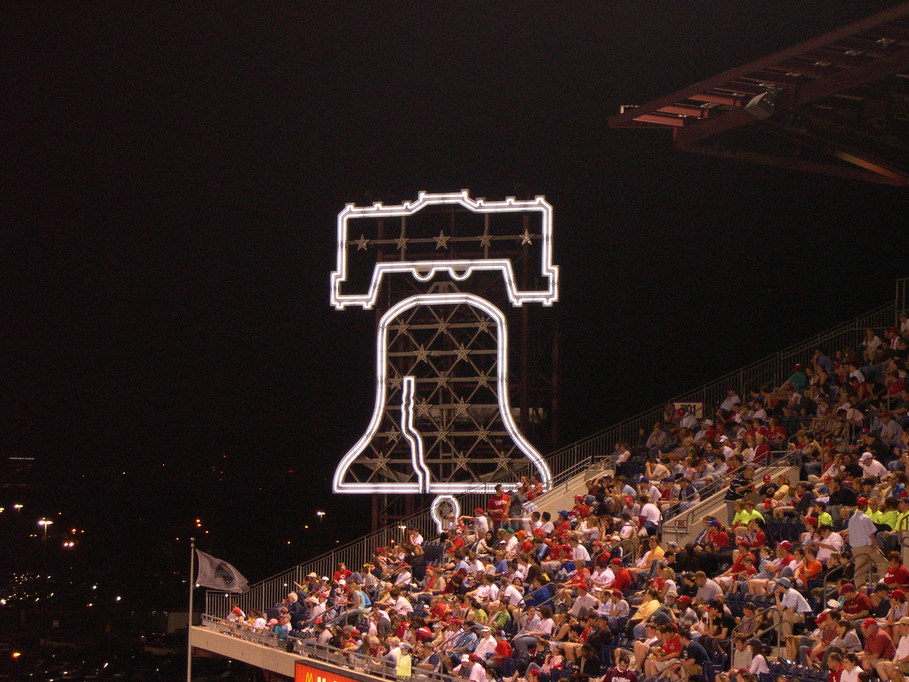
We spent Saturday afternoon at the ballpark. After not making it to any major league games last year, I managed to attend a game this year before the season even started. It was the first time I've ever attended a spring training game, if you can call a game in barely 50 degree weather with a 20+ mph wind blowing in from center field part of spring training. The Phillies lost to the Blue Jays 5-3 in a pretty uninspiring game. It was my first visit to Citizens Bank Park. It's pretty similar to most of the new baseball parks. It's more comfortable than the classic ballparks and more attractive than the second-generation multipurpose stadiums, but it feels kind of sterile. My favorite feature as the giant lighted Liberty Bell sign in right field that animates and rings whenever a Philly hits a home run.
Philadelphia is interesting because all of its sporting venues are right next to each other. Citizens Bank Park is located next to site where Veterans Stadium used to stand (it's now a parking lot). Across the street is the old Philadelphia Spectrum. I thought that the Spectrum had been torn down years ago, but it's still being used by Philadelphia's second-tier professional sports franchises (Phantoms, Kixx, and Soul). Behind the Spectrum is the Wachovia Center, where the Flyers and the Sixers play, and across from there stands the Eagles new home, Lincoln Financial Field. It kind of makes sense to build all of these venues next to each other, though it probably gets pretty crowded in the early fall when all four of the major professional sports leagues are in session.
After the game, we went on a South Philadelphia pub crawl. We started at the Pub on Passyunk East (P.O.P.E.). It featured a diverse selection of craft beers, Bell's Two-Hearted Ale on tap, and Operation Ivy playing on the jukebox when we walked in. Needless to say, I was a big fan of this place.
Our next stop was a few blocks up the street at a neighborhood watering hole called The Triangle Tavern. The tavern was empty, sans a few guys who I can only assume are regulars, and by regulars, I mean guys who spend at least 20 hours a week there. The sun was still up when we arrived at the Triangle, but it had long since set by the time we left. Geno's and Pat's, South Philly's world-renowned culinary institutions were conveniently located between the tavern and our final stop for the evening. We stopped at Geno's, if for no reason then we were already on that side of the street. Geno's is a monument to Italian-American culture, where the only thing more over the top than their garish decor is their reactionary patriotism. I have to imagine that there aren't too many illegal immigrants who are crying themselves to sleep because they will never have the privilege of paying $7.50 for a six-inch sandwich with 4oz of chopped steak and a dollop of Cheese Whiz. I was talking to a native Philadelphian a while back who felt that both of Philly's iconic cheese steak shops had gotten a bit too tourist-trappy over the past few years and while this was my first visit to either, I would tend to agree. Still, I was pretty hungry and intoxicated by the time we got there, so everything tasted pretty good.
Our final stop of the night was a place called The Dive. By definition, no bar that calls itself a dive can actually be a true dive bar, and The Dive was no exception. It was full of guys with odd facial hair and the walls were covered with handmade flyers from past shows by bands with ironic names. We drank $9 worth of Schlitz (6 cans) and called it a night.
Friday, March 28, 2008
Survey Says
I received a phone call yesterday evening asking me if I wished to participate in a survey. I gladly obliged, partially because I am a shut-in whose only contact with the outside world is my blog and mis-dialed phone calls, but mostly because I feel like it's my duty to compensate for all of the idiots America's survey takers seem to talk to each time they conduct a survey. Every time I hear about a survey that shows that 90% of Americans think the sun revolves around the earth or something like that, I get upset about the rank ignorance that the survey uncovered, but then I get upset that I was never consulted. It's not like me answering the question correctly would have affected the outcome (unless they were using an incredibly flawed sampling methodology), but I feel like those of us who are not crippled by ignorance, willful or otherwise, have a duty to stand up and be counted.
The survey I participated in was about legal proceedings initiated by the town of North Tiverton against the Southern Union utility company over soil contamination resulting from the dumping of toxic coal gasification wastes from as far back as the 1940s. I didn't ask, but my guess is that the survey was paid for by the utility company since the questions were definitely slanted in their favor. It started out with some questions to tease out my political orientation. I was asked about how I felt about Senators Clinton, Obama, and McCain as well as I how felt about the Governor of Rhode Island. I was also asked how I felt about Microsoft, National Grid, New England Gas, and the EPA. I get the questions about utility companies and the EPA, but why Microsoft? Perhaps animosity towards Microsoft a good proxy for general anti-business attitudes? After that, I was presented with a "hypothetical" situation where a utility company paid a trunking company to dump toxic wastes in an approved dump site, but the trunking company went ahead and dumped the wastes somewhere else and was asked who I felt should be held liable. This was presented as an either/or kind of question, which I found to be somewhat loaded, so I basically said that while I would hold the trucking company responsible for the illegal dumping, if the utility company didn't do their homework and just sent their waste out without making sure that the company they contracted with was actually going to dispose of it properly, they share some of the blame. I have to give the survey taker a lot of credit, he didn't try to force me to side with the utility or the trucking company, he just took down what I said and left it at that. The survey then ended with some standard demographic questions.
I looked into the story a little bit after doing the survey. I haven't found anything about a rogue trucking company in either of the ProJo articles I found, but this case has been going on for quite a while and I don't feel like doing an exhaustive search. Unfortunately, this wasn't a survey with right and wrong answers so I didn't get to cancel out anyone else's stupidity with my answers, but I still feel like I did my duty.
Thursday, March 27, 2008
Shilling For Dollars
I've been seeing these Hyundai commercials a lot recently. In an effort to make buying a new car look like a shrewd financial move, Hyundai has recruited three authors of personal finance books to appear in commercial spots and dispense nuggets of financial wisdom along with a hearty side of condescension. I don't see how these commercials help Hyundai or the authors. These guys may all be best selling authors, but they aren't bringing any star power to Hyundai. In each spot, the writers have to be introduced by the customer blurting out an utterly ridiculous line, such as "Adam Smith? Best selling author of The Money Game?" in order for the viewers to know who they are. The writers may drum up some extra sales for their books by appearing on TV, but they are doing so at the cost of turning themselves into shills for Hyundai. The conflict of interest doesn't rise to the level of a Ford ad campaign I saw a few years ago that featured an automotive writer whose name I forget gushing over the new Ford Freestar, but I think it's still a conflict of interest. Cars are one of the biggest purchases that people make and nearly every personal finance book that I've read has spent some time discussing common financial mistakes that people make when buying cars and how to avoid them. As if all of this wasn't enough, the authors come off like a bunch of know-it-all jerks in these commercials. Adam Smith's "Which one of us is a Rhodes Scholar" retort is especially nauseating. If you're like me and found it a little bit too suspicious that there's a financial writer named Adam Smith, I can save you a trip to Wikipedia by confirming that it is a pseudonym. His real name is George Goodman.
Tuesday, March 25, 2008
Crazy Straw
There is an irritating linguistic trend that appears to slowly be gaining traction in my office right now. I've been hearing people use the term "straw man" to describe what would more appropriately be called a first draft. The way I've always understood the term matches what Wikipedia and Merriam-Webster have to say, a straw man is not an argument that is made in good faith; it's an easily refutable misrepresentation of an opponent's position. I suppose it's possible that my co-workers are so devious that they are creating straw man arguments designed to discredit all of my work and ideas and cleverly disguising them as a rough drafts, but I kind of doubt it. Anyway, I hope that this fizzles out before it moves its way up the management chain, since I've found that all annoying and grammatically incorrect words and phrases that are used by upper management get parroted all the way down the org chart.
Monday, March 24, 2008
Juno What I Mean
Juno comes out on DVD on tax day (which is coming up, BTW), so it only makes sense that we finally went out to catch it in the theater this past weekend. One advantage of going to see a movie that's been playing for three months is that you don't have to worry about getting a good seat. As it turned out, we were the only two people in the theater for the showing that we attended.
There were a lot of things that I didn't like about this movie. I'll start of with the superficial - why were high schoolers listening to CDs and talking to each other on land line telephones? I was under the impression that everyone over the age of 13 has a cell phone and a lot of them might not know what a CD looks like. Moving on, I found most of the soundtrack unbearable. I didn't mind that all of the main characters were portrayed as a decent, likable human beings, but I thought that the movie had a surprising lack of conflict, especially considering the subject matter at hand. When conflicts did occur, they always seemed to resolve themselves off-camera and everything was back to normal by the time the characters appeared in another scene together.
I still enjoyed the movie, but it didn't really impress me the way it seems to have impressed a lot of people. I really felt like Michael Cera's character was underutilized, but maybe that was on purpose. Had he been more prominent, it would have made the movie into more of a standard teenage pregnancy story.
Sunday, March 23, 2008

Friday, March 21, 2008

Wednesday, March 19, 2008
Down the Drain
According to MDS, China is retrofitting the facilities that they built for the upcoming Summer Olympics with western-style sit-down toilets after receiving complaints about their squat toilets. I'm kind of surprised that they didn't put sit-down toilets in all of the new construction that they're doing for the summer games. I didn't see very many squat toilets on my visit to China last fall and I assumed that they had pretty much stopped using them in new construction.
The strangest lavatory related thing that I saw in China was shared washbasins. In several places that I visited, instead of having washbasins instead of the men's and women's restrooms, a shared set of washbasins was placed outside of the restrooms. It didn't bother me, but I don't think it would go over very well in the west. From what I've been able to ascertain, there are a number of culturally significant rituals that are performed at the sinks in ladies rooms across the western world that most women would rather not have to conduct in full public view.
The strangest lavatory related thing that I saw in China was shared washbasins. In several places that I visited, instead of having washbasins instead of the men's and women's restrooms, a shared set of washbasins was placed outside of the restrooms. It didn't bother me, but I don't think it would go over very well in the west. From what I've been able to ascertain, there are a number of culturally significant rituals that are performed at the sinks in ladies rooms across the western world that most women would rather not have to conduct in full public view.
Tuesday, March 18, 2008
At Last
I tend to be a latecomer to all things online, so it's with equal parts joy and shame that I'm professing my new found love for the social music website last.fm. I had certainly heard of last.fm before, though I'm not sure when or how it entered my consciousness. For whatever reason, I never checked it out until I searched for a recording of Freddie Hubbard's Up Jumped Spring to link to in a post I wrote last week. The first relevant search result that came up was from last.fm and needless to say, I was impressed with what I found. I've really been jonesin' for new music since I'm no longer able to listen to the greatest terrestrial radio station on earth (via the internet) at work anymore and I haven't been making it to very many live shows lately. I've already heard more interesting new (to me) stuff on last.fm in the past two days than I had heard in the previous year. If you're sick of listening to the same old stuff, give it a try.
Monday, March 17, 2008
Irish I Were Drunk

We enjoyed another St. Patrick's day in Newport this year. Pictured above is yours truly in full St. Patrick's day regalia holding a bottle of Newport Storm. We spent the day at the parade, party hopping, and playing da cau in the street. We then hit some of the finer eating and drinking establishments in town before collapsing around midnight. I was pleased to learn that one of the perhaps several drunken neologisms that our group coined on Saturday is a semi-legitimate word. Insinuendo, meaning to insinuate through innuendo, is obviously redundant, but it has a nice ring to it and it has been part of the English language since at least the 1870s, according to this.
Sunday, March 16, 2008
Walk and Run
We watched Walk the Line today. We both enjoyed the movie, but we especially enjoyed the music. Neither of us are big Johnny Cash fans, so familiarity with his music is certainly not a prerequisite for enjoying the movie. I really liked how a lot of scenes used music instead of dialog to tell the story. Letting Cash's lyrics and his interaction with June Carter on stage tell the story was a lot more effective that trying to act it out would have been.
I was surprised to learn how much of Cash's early career coincided with the careers of early rock and rollers like Elvis and Jerry Lee Lewis. I've always thought of Johnny Cash as more of a country musician. Early rock and roll has a lot of country music influence in it, of course, so this didn't come as a complete surprise. Had I ever really sat down and listened to Cash's music, I'm sure I would have made that connection.
I also finally finished reading Rabbit, Run by John Updike. It wasn't really on my to-read list, but I received a copy of it at a yankee swap last Christmas and decided to give it a shot. I really enjoyed it, but unfortunately, I read most of it in 15 minute chunks over the past two months. I don't think that's a good way to read anything, but it's an especially bad way to read a story full of such vivid language and rich characters. It's not a heavy book, you could probably read most of it on a long flight, but it's the kind of story that draws you in so completely that you really should plan on spending some quality with the book ever time you crack it open. The other downside is that it's the first book in a series of four and none of the plots threads that were opened in Rabbit, Run are tied up by the end of the book. My copy contains the first two books in the series, and while I'd really like to jump right into the next book (Rabbit Redux) so I can get some closure, I'm going to try and clear a few more titles of off my to-read list before going back. I may even decide to re-read Rabbit, Run and go straight into Rabbit Redux just so I can give the story the attention that I think it deserves.
Wednesday, March 12, 2008
Spit Take
I don't have anything insightful to add to the Elliot Spitzer discussion, but if someone decides to make a movie about him, I have the perfect actor for the role. I've always thought that actor & comedian Larry Miller was a dead ringer for Spitzer. I have a tendency to see look-alikes that no one else agrees with, but I'm pretty confident about this one.


Tuesday, March 11, 2008
Stupid Korean Camera
Michelle told me about this interview a couple a weeks ago and I finally got a chance to listen to it. It's a discussion with Stephen Dodson, a linguist who has devoted much of his life to the study of curse words. In the interview, he discusses how curse words evolve within and between languages. He doesn't mention too many curses during the interview, but he does drop a câlice and a tabarnak, two of my favorite foreign language bad words. They are part of the Québécois dialect and literally translate to chalice and tabernacle. I'm pretty sure that tabarnak was the first foreign language curse word I ever learned. I learned it from a classmate in third grade who had recently moved to the US from Quebec. I was in Montreal last summer and walked into a funny t-shirt store that was selling a shirt that had tabarnak emblazoned across the front along with a couple of fleurs-de-lis. I thought about buying it, but realized that it probably wasn't a great idea. For one, I've never really considered apparel that features English swear words to be all that classy, so why make an exception for French-Canadian profanity. On top of that, it's impossible to asses the relative strength of curse words in a language that you don't speak, so I had no way of knowing whether or not most Québécois speakers would find the t-shirt mildly amusing or deeply offensive.
Monday, March 10, 2008
Up Jumped Spring
I realize that spring doesn't officially start for another week and a half, but now that daylight savings time is in effect and I actually see daylight when I leave the office, it sure feels like spring has sprung. Living on the far eastern edge of the eastern time zone means that in the dead of winter, it gets dark here before 5pm. I got an early glimpse a couple weeks ago when I left work a little early, but until that point, I really hadn't noticed that the days were slowly but surely getting longer. It's still seasonably cool here, but being able to see daylight at the end of the workday is quite a boost for the psyche.
If you'd rather celebrate something that actually happened today, you can celebrate the first annual National Registered Dietitian Day. Go eat something healthy.
If you'd rather celebrate something that actually happened today, you can celebrate the first annual National Registered Dietitian Day. Go eat something healthy.
Sunday, March 09, 2008

Thursday, March 06, 2008
PREMIUM! DUUUUUDE!!
I was pumping gas at my local Shell station recently when I noticed that they only had two grades of gas, regular and premium. It wasn't that they were out of the middle grade, they were no longer selling it. I can't imagine that middle grade gasoline was every a big seller. I tend to be the kind of person who, when offered three product levels, goes for the one in the middle even though the top version is always a better value, but I've never intentionally bought middle grade gasoline. Most manufacturers recommend that you put regular unleaded gasoline in your car, so unless you've driving an exotic sports car, there's no point it buying anything other than regular gasoline. I drove past another nearby Shell station yesterday and noticed that they're still selling middle grade gas, so it's not a company-wide thing just yet. If you aren't sure what I was referring to in the title of this post, check here. I can't think about gas stations or even the word 'premium' without replaying that scene in my head.
Tuesday, March 04, 2008
Totally Uncommitted
When I went to vote this morning, I was surprised to see that one of the choices for President was Uncommitted. I don't recall ever seeing an option like that on an election ballot before. Given that the only things that was on the ballot today in Rhode Island were the Presidential nomination and the delegates to the conventions, I'm not sure why anyone who didn't want to cast a vote for any of the candidates would even bother showing up. Perhaps it's on the ballot to give people the ability to cast a protest vote if they don't like any of the candidates.
Monday, March 03, 2008
Let's Stay Together
One of my favorite blogs has been running ads for a Christian online dating service called Together Christian. Not being in the market for online dating services, Christian or otherwise, I normally don't pay much attention to these ads, but it's hard to miss this one, thanks to the busty blonde woman in a tank top they used in their ad.

I don't think I've ever seen sex appeal used to sell religion (or in this case, products & services to the religious) in quite this manner before. For what it's worth, the women in the JDate billboard that I blogged about a couple years ago are also wearing tank tops, though they aren't as skimpy as the one worn by the Together Christian woman. What any of this says about anything I'm not about to speculate, but it's always interesting to see how religion is marketed. In 20 years time, this [warning - audio link] Onion story from a couple years back may not seem so far-fetched.
I don't think I've ever seen sex appeal used to sell religion (or in this case, products & services to the religious) in quite this manner before. For what it's worth, the women in the JDate billboard that I blogged about a couple years ago are also wearing tank tops, though they aren't as skimpy as the one worn by the Together Christian woman. What any of this says about anything I'm not about to speculate, but it's always interesting to see how religion is marketed. In 20 years time, this [warning - audio link] Onion story from a couple years back may not seem so far-fetched.
Sunday, March 02, 2008

Subscribe to:
Posts (Atom)